- The AIDA model is a foundational advertising and marketing framework that describes the psychological stages a consumer goes through before purchasing a product or service.
- It was developed by E. St. Elmo Lewis in 1898.
- Initially created for salespersons, it has become a “blueprint” or roadmap for marketers to design effective communication campaigns across print, TV, and digital media.
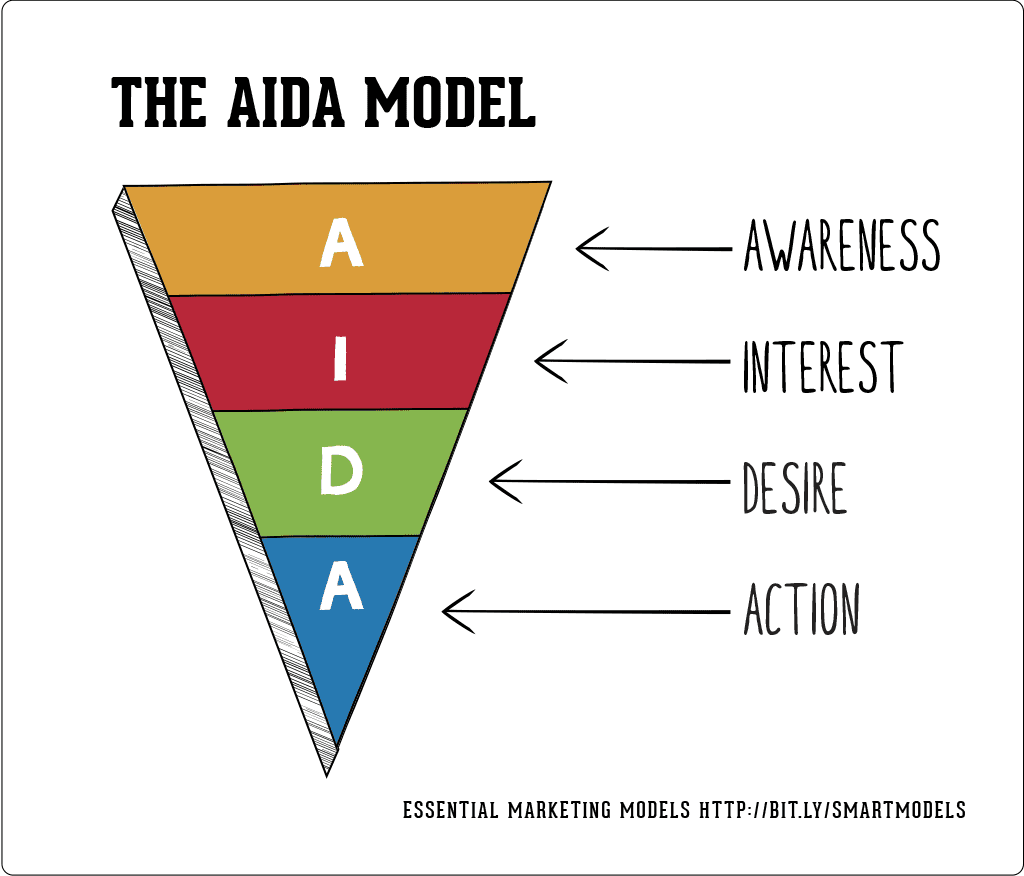
The Four Stages of AIDA
- Attention (Awareness)
- Goal: To stand out in a “crowded room” or noisy media environment and grab the customer’s eye.
- Techniques:
- Visuals: Using bold colors, striking images, unique layouts, or attractive typography.
- Celebrities: Utilizing famous personalities to build immediate recognition.
- Audio: Catchy jingles or sounds in radio and TV ads.
- Hooks: Provocative questions or catchy headlines that make a person stop and pay attention.
- Interest
- Goal: Once attention is caught, the focus shifts to keeping the consumer engaged by answering “Why should they care?”
- Techniques:
- Problem-Solving: Presenting the product as a solution to a specific problem.
- Features & Benefits: Highlighting what makes the product special or different from competitors.
- Engaging Content: Using videos, infographics, or detailed descriptions to explain the value proposition.
- Desire
- Goal: To move the consumer from “liking” the product to “wanting” or “needing” it.
- Techniques:
- Emotional Connection: Tapping into feelings like success, health, or happiness.
- Storytelling: Sharing success stories or scenarios where life becomes better after using the product.
- Social Proof: Using testimonials or demonstrations to build trust and show the product’s effectiveness.
- Action
- Goal: To prompt the consumer to take a specific, immediate step.
- Techniques:
- Call to Action (CTA): Providing clear instructions such as “Download Now,” “Buy Today,” or “Visit your nearest store.”
- Incentives: Offering discounts, limited-time promotions, or exclusive deals to create a sense of urgency.
- Simplicity: Ensuring the next steps are easy and frictionless for the customer.
Benefits and Drawbacks
Benefits:
- Structured Communication: Provides a clear and simple guide for creating focused marketing messages.
- Customer-Centric: Focuses on the consumer’s psychological journey rather than just the brand’s needs.
- Versatility: Can be applied across various industries, from physical products to digital services.
Drawbacks & Limitations:
- Over-Simplicity: It may ignore complex factors like personal values, social influences, and past experiences.
- Non-Linear Journey: In the digital age, customers often skip stages, go backward, or research extensively before acting.
- Rational Bias: It assumes buyers make mostly logical decisions, often overlooking impulsive or purely emotional choices.
- Lack of Post-Purchase Focus: The model ends at “Action,” neglecting critical steps like customer loyalty, repeat purchases, and post-sale services.